
Manufacturing ERP
Tax Invoice Format Sri Lanka 2026 | VAT Compliance PDF (2481/22)
Download the Sri Lanka tax invoice format PDF (Gazette 2481/22): VAT invoice format compliance 2026 fields—TIN, serial, line VAT—mapped for ERP and RAMIS before July 2026.
Comparing ERP vs accounting software, LKR TCO bands, and VAT-ready invoicing for Sri Lankan teams?
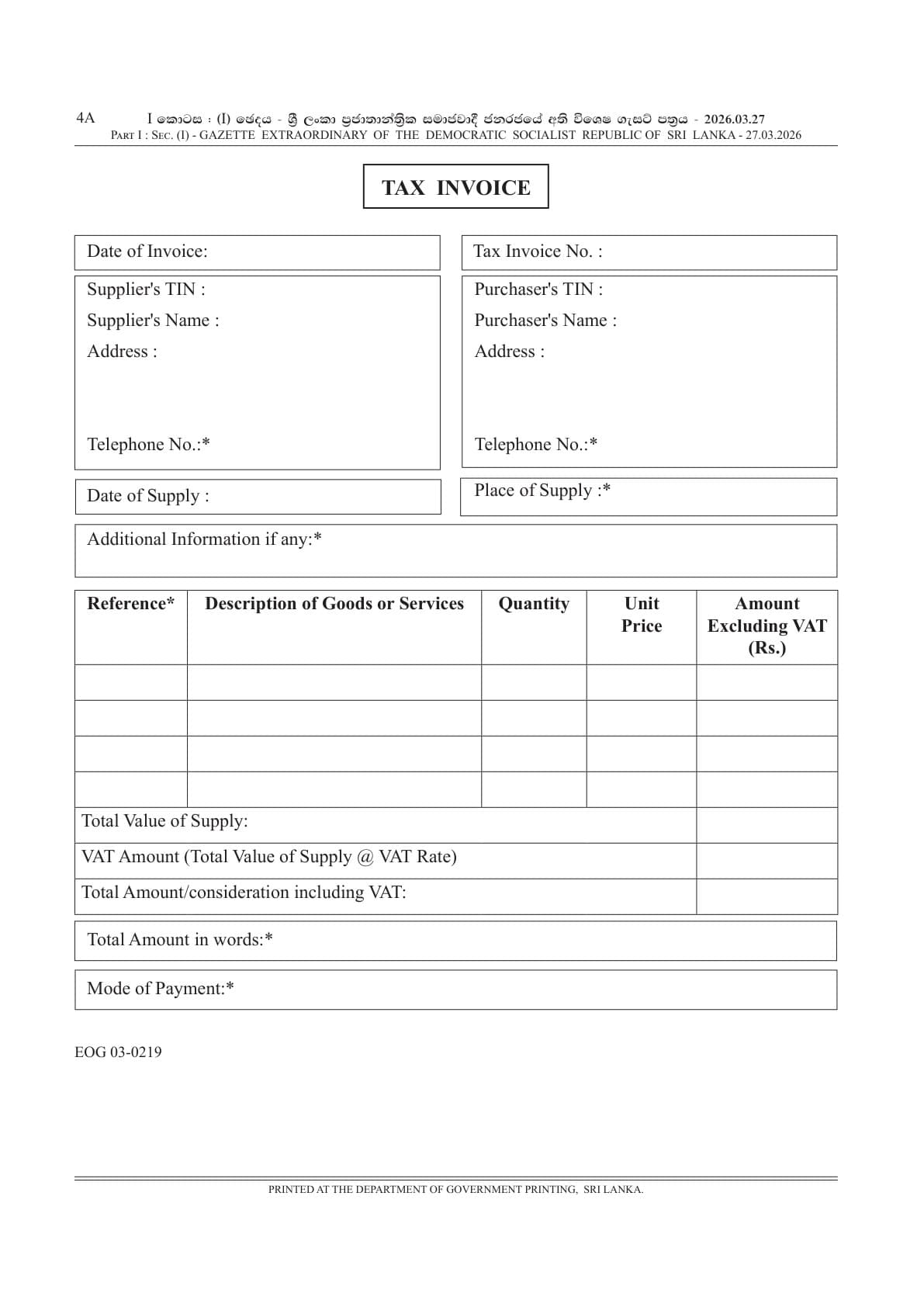
Businesses searching for VAT invoice format compliance 2026, the Sri Lanka tax invoice format, VAT invoice format, or Gazette 2481/22 specimen usually want one practical answer: which fields must the ERP produce correctly every time? Gazette Extraordinary 2481/22, dated 27 March 2026, provides a specimen TAX INVOICE layout effective from 1 July 2026, and rescinds the earlier November 2025 specification from that date. For the full buyer path beyond invoice fields, see ERP software in Sri Lanka.
The format is more than a document design. It is a data model for VAT invoicing: supplier identity, purchaser identity, invoice number, invoice date, supply date, taxable line details, VAT amount, total value, optional supply information, and payment method must all come from controlled ERP records—not free-text notes.
This page is Capricon’s field-mapping pillar for Gazette 2481/22. Download the one-page tax invoice field checklist (PDF) for ERP workshops, then pair it with the RAMIS VAT e-invoicing Sri Lanka overview when you need API and schedule readiness, not only PDF layouts.
Required invoice header fields
- The document title should clearly read TAX INVOICE in a conspicuous position.
- The supplier section should include the supplier’s 9-digit TIN, name, and address from VAT registration records.
- The purchaser section should include the purchaser’s 9-digit TIN, name, and address where required.
- The invoice date and date of supply should be available in MM/DD/YYYY format.
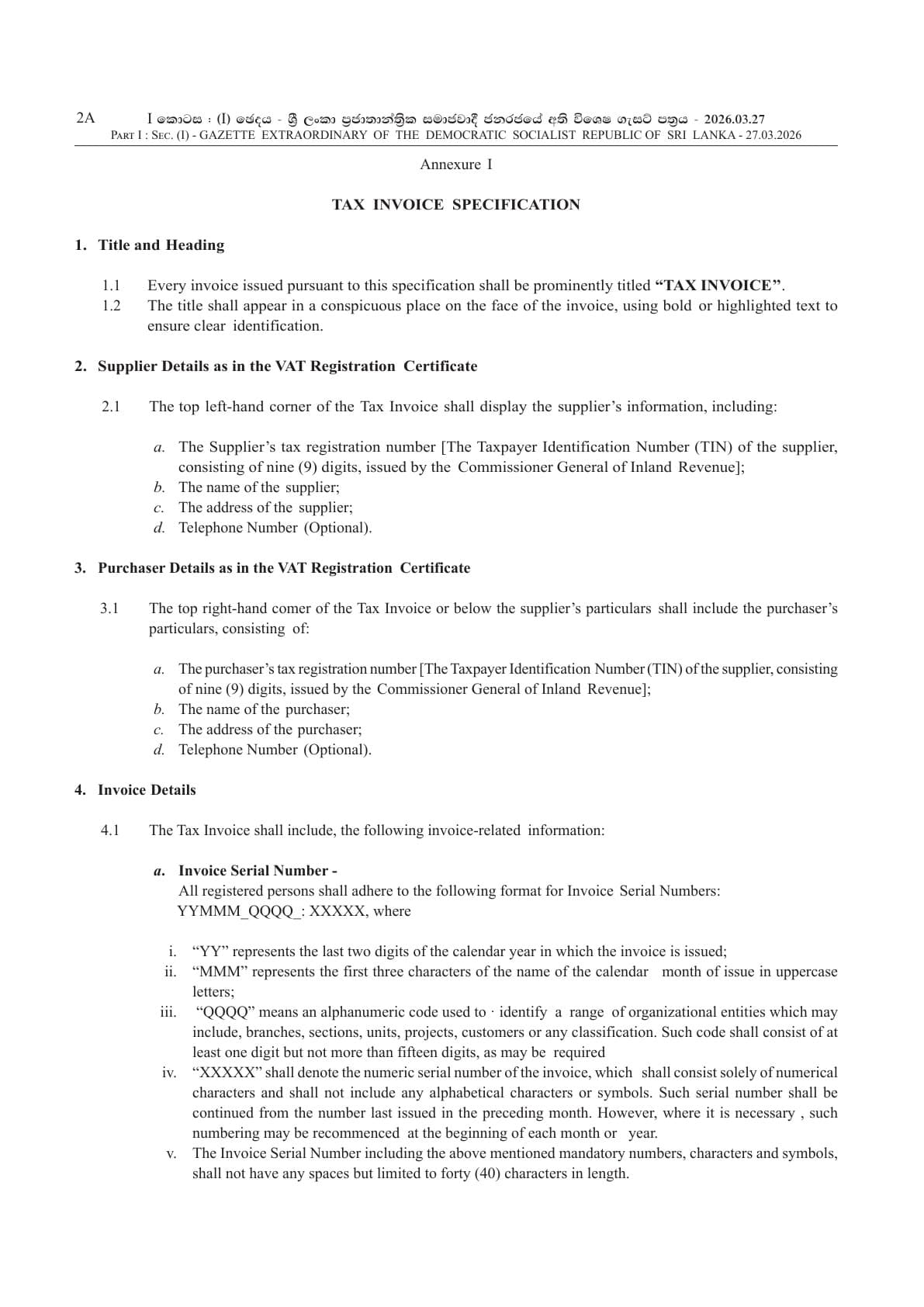
- The tax invoice number should follow the standardized serial number structure without spaces and within the 40-character limit.
Line and value fields the ERP must control
- Reference or item identifiers for goods or services supplied.
- Clear goods or services descriptions that match operational records.
- Quantity or volume for measurable supplies.
- Unit price and amount excluding VAT in Sri Lankan Rupees.
- Total value of supply, VAT amount, and total consideration including VAT.
- Optional total amount in words and mode of payment where available.
Serial numbers, TINs, and common template mistakes
Most failed VAT invoice audits start with weak master data. TINs typed into a Word footer drift from the VAT registration file. Manual serials collide across branches. Date formats differ between print and PDF. ERP mapping prevents those failure modes by treating the gazetted layout as output—not as the source of truth.
- Never allow blank or duplicate serials at post time; block save if the sequence rule fails.
- Validate 9-digit TIN length and forbid spaces in serial and TIN fields at entry.
- Keep branch or unit codes inside the serial rule if multi-branch retailing needs unique numbering.
- Store supply date separately from invoice date so delayed billing stays accurate.
- Reject mixed taxable and non-taxable lines on a tax invoice when rules require a clean taxable supply document.
ERP mapping checklist
- Map supplier and purchaser TIN fields from master data, not from free-text invoice notes.
- Generate invoice serial numbers from controlled ERP sequence rules instead of manual typing.
- Separate VAT-taxable goods or services from non-VAT items so the tax invoice contains only appropriate lines.
- Keep original invoice, credit note, and debit note references linked for audit traceability.
- Test printed invoice, PDF invoice, email invoice, export file, and API payloads against the same source transaction.
- Confirm VAT schedules and credit/debit notes still reconcile after template changes—see VAT schedules and credit/debit notes.
From tax invoice format to RAMIS e-invoicing
A correct Gazette layout is necessary but not sufficient once invoice and schedule data must move into RAMIS. If ERP fields are inconsistent, Web API submissions fail even when the printed PDF looks right. Use this pillar for field truth, then the RAMIS VAT e-invoicing checklist and RAMIS Web API questions for ERP teams for transmission readiness.
How Capricon Core supports the format
Capricon Core can support Gazette 2481/22 readiness through configurable invoice templates, TIN-aware customer and supplier records, controlled serial-number rules, VAT line calculations, approval workflows, and audit-ready reporting. These controls help finance teams produce consistent invoice data for print, digital sharing, and future integration workflows.
Next: ERP, RAMIS, and invoice controls
- Buyer path: ERP software in Sri Lanka — TCO, VAT-ready invoicing, and when to leave accounting packages.
- E-invoicing lander: RAMIS VAT e-invoicing Sri Lanka.
- Product: Capricon Core ERP for TIN masters, serials, and VAT lines.
- Personalised gap list: cash & VAT readiness audit or the retail ERP case study.
As with any tax configuration, businesses should validate final invoice layouts, field rules, and rollout timing against the latest IRD publication and professional tax advice before issuing live invoices.
Frequently asked questions
What is VAT invoice format compliance 2026?
VAT invoice format compliance 2026 means issuing tax invoices that match Gazette Extraordinary 2481/22 from 1 July 2026—supplier/purchaser TINs, controlled serials, line VAT, and totals—from ERP-controlled data, with a clear path to RAMIS e-invoicing later.
What is the Sri Lanka VAT tax invoice format for 2026?
Gazette Extraordinary 2481/22 (27 March 2026) sets the specimen TAX INVOICE layout effective from 1 July 2026. It standardizes supplier/purchaser TIN, name and address, invoice and supply dates, serial numbering, line details, VAT amounts, and totals for VAT-registered supplies.
What is Gazette 2481/22 tax invoice format?
It is the Inland Revenue–aligned specimen that replaces the earlier November 2025 specification from July 2026. Use it as the field reference when configuring ERP print templates, PDF invoices, and future RAMIS API payloads—not only as a Word layout.
Which fields must my ERP map for VAT invoices in Sri Lanka?
At minimum: document title TAX INVOICE, supplier and purchaser 9-digit TINs with name/address, invoice date and date of supply, controlled serial number (no spaces, within length rules), item descriptions, quantity, unit price and amount excluding VAT, VAT amount, and total consideration including VAT. Credit and debit notes must link back to the original invoice.
Is a Word or Excel invoice template enough for IRD compliance?
A static template only helps if every field is filled from controlled master data and numbering rules. Spreadsheet or Word invoices break serial control, TIN validation, and audit trails—and will not support RAMIS e-invoicing when API submission is required.
Can I claim VAT without a valid tax invoice?
No. Input tax credit depends on holding a tax invoice that meets the Gazette 2481/22 requirements—supplier and purchaser TINs, a controlled serial number, line-level VAT, and totals. An invoice missing required fields can be rejected at audit, which turns a supplier's paperwork problem into your cash problem. Check invoices on receipt, not at year end.
Does a tax invoice need an invoice number?
Yes, and it must come from a controlled sequence rather than being typed per invoice. Serial control follows a year/month/unit/sequence structure with no gaps and no reuse. Manual numbering in Word or Excel is the most common way this requirement breaks, because nothing prevents two invoices sharing a number or a gap appearing when a draft is discarded.
Can a tax invoice also be a receipt?
They serve different purposes and should not be conflated. A tax invoice evidences the supply and the VAT charged; a receipt evidences that payment was made. A single printed document can carry both sets of information, but the tax invoice fields required by 2481/22 must all be present—labelling a payment slip as a tax invoice does not make it one.
When should a VAT invoice be issued?
At the time of supply, within the period set by the VAT Act—not whenever the paperwork is convenient. Late issuance is a common finding because invoices are batched at month end from delivery notes. If your ERP raises the invoice from the same transaction that records the supply, timing takes care of itself.
Does a VAT invoice need to show the VAT number?
Yes. Both the supplier's and the purchaser's TIN must appear. This is the field most often missing on invoices from smaller suppliers, and it is the field that most reliably invalidates an input credit claim. Pull TINs from customer and supplier master data so they cannot be omitted or mistyped per invoice.
How does Capricon help with Gazette 2481/22 readiness?
Capricon Core supports TIN-aware masters, controlled invoice serials, VAT line calculation, credit/debit note links, and audit-ready output. For a gap review across invoice fields, payments, and RAMIS readiness, book Capricon’s cash & VAT readiness audit or the RAMIS VAT e-invoicing lander on Capricon.biz.
Related Capricon solutions
Explore tools and services for manufacturing erp
Related guides on this topic
- Sri Lanka RAMIS VAT E-Invoicing Checklist for ERP Teams (2026)
- Sri Lanka VAT Invoice Checklist 2026: TIN & Serial Validation
- Sri Lanka 2026 VAT E-Invoicing: How ERP Systems Should Prepare for RAMIS Integration
- Sri Lanka POS Machines and VAT E-Invoicing: What Retailers Should Prepare Before Phase III
Related Capricon product & services
- Capricon Core ERP
VAT-ready invoicing, inventory, and finance for Sri Lankan businesses.
- ERP software Sri Lanka
Buyer guide: modules, LKR TCO bands, cloud vs on-premise, and accounting-vs-ERP signals.
- Capricon Pay payment portal
Centralize collections and reconcile LankaQR / JustPay settlements with ERP.
- RAMIS VAT e-invoicing Sri Lanka
Gazette 2481/22 fields, schedules, and ERP-to-RAMIS readiness overview.
- Tax invoice checklist (PDF)
One-page Gazette 2481/22 field checklist for ERP / POS workshops.
- Cash & VAT readiness audit
Book a structured review of cash matching, payment rails, and VAT invoice readiness.
Ready to take your business to the next level?
Your next big move starts here - take charge, scale up, and lead your business to success.